The Truth About the Alienware Aw3425Dw: Pros, Cons, and Verdict
Introduction
The Alienware Aw3425Dw arrived amid high expectations: an ultrawide monitor aimed at gamers and creative professionals who want an immersive, high-performance display. Ultrawide OLED panels have become particularly attractive because they combine dramatic contrast and near-instant pixel response with the extra horizontal workspace that many users prize. This article examines the Aw3425Dw in practical terms—how it performs in real-world scenarios, who should consider buying it, and where it might fall short compared to competing options.
At a glance: what the Aw3425Dw offers
The Alienware Aw3425Dw positions itself as a premium 34-inch ultrawide designed to prioritize contrast, color pop, and fluid motion. For readers evaluating this monitor, the most important characteristics are the ultrawide form factor, an emissive (OLED-based) panel technology that delivers deep blacks and high contrast, and a performance-oriented feature set tailored to modern gaming GPUs. Buyers typically care about image quality, motion clarity, connectivity, ergonomic fit, and long-term reliability—this review addresses those areas with practical context.
Detailed review and analysis
Design and build
The Aw3425Dw follows Alienware’s recognizable aesthetic: a solid, gamer-forward chassis, a curved ultrawide screen, and a stand with adjustable height and tilt. Build quality generally feels premium—materials and finish are designed to match high-end desktops and peripherals. The monitor’s curve produces a more enveloping field of view, which is particularly effective in racing and flight simulators where peripheral immersion adds to realism. Users with compact desks should measure first; ultrawide curvature requires some depth to sit at the sweet spot for viewing comfort.
Panel characteristics and image quality
Where the Aw3425Dw stands out is the emissive panel’s black levels and contrast. OLED-style panels produce true blacks because each pixel emits its own light and can be turned off entirely, which makes dark scenes in games and movies look exceptional. Colors typically appear vivid and saturated without the “washed” look sometimes associated with lower-contrast panels.
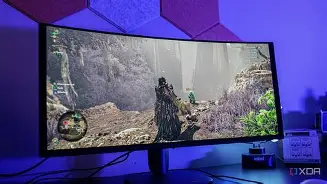
For creative work, the monitor’s color reproduction tends to be impressive out of the box, with wide gamut coverage that benefits photo and video editing. However, professionals who demand absolute color accuracy should still use a colorimeter and check the monitor’s factory calibration reports if exact color-critical work (print proofing, high-end grading) is involved. Calibration can tighten grayscale tracking, gamma, and white point for predictable results.
Motion performance and gaming
Gaming on the Aw3425Dw delivers a different sort of advantage than a faster TN panel: OLED-type panels achieve extremely low pixel response times, which reduces trailing and ghosting in fast-moving scenes. Coupled with a high refresh rate supported by modern GPUs, the monitor offers fluid motion that benefits first-person shooters, racing titles, and competitive multiplayer.
Adaptive sync (NVIDIA G-SYNC or similar compatibility) reduces tearing and stuttering when frame rates fluctuate. The ultrawide aspect ratio also enhances peripheral awareness in many games, giving a wider field of view without needing multiple-monitor setups. It’s worth noting that some competitive players still prefer narrower, higher-refresh displays for maximum frame rates and reduced head turn; the ultrawide experience is more about immersion and situational awareness than raw competitive edge.
HDR and brightness behavior
OLED panels shine in local contrast and shadow detail, but HDR performance depends on peak brightness and tone mapping. In practice, the Aw3425Dw produces striking HDR highlights and rich shadows due to contrast, but it may not match the extreme peak brightness of some high-end mini-LED or full-array local dimming displays. This means HDR content looks dramatic and natural in many scenes, particularly darker ones, but in very bright environments or in footage relying on very high specular highlights, the maximum shine may appear less intense than on brighter LED-based HDR monitors.
Discover deals on Laptops & Computers — updated daily.
Shop Amazon →Ports, connectivity, and ergonomics
Practical connectivity—DisplayPort, HDMI, and USB downstream ports—makes the monitor suitable for modern desktops and gaming laptops. Users should verify the exact port versions if they plan to run high refresh rates at native ultrawide resolution: ensuring the GPU output and cable specification can handle the required bandwidth is essential for a trouble-free experience. The stand commonly offers tilt and height adjustment; some users prefer mounting on an arm for more flexible positioning or improved desk ergonomics.
Longevity concerns: burn-in and image retention
The primary long-term consideration with emissive panels is the risk of image retention or burn-in when static elements are displayed for prolonged periods. Real-world users who run static UI elements—toolbars, HUDs, or software panels—half the day are the most vulnerable. Manufacturers mitigate risk with software measures (pixel shifting, screensavers, and refresh cycles), and responsible use—avoiding static images at full brightness for extended stretches—reduces the probability of permanent burn-in. For users who expect heavy, static UI use (trading platforms, professional dashboards, or certain productivity setups), an emissive ultrawide might not be the optimal pick.
Everyday productivity and creative workflows
For productivity, the ultrawide canvas is a genuine advantage: side-by-side windows for documents, reference material, and messaging apps reduce the need for multiple monitors. Content creators gain a long horizontal timeline for video editing, and photographers appreciate room for tool palettes beside the image preview. Ergonomic concerns matter—text scaling and UI sizes should be adjusted for comfortable reading at typical desk distances.
Pros & Cons
- Pros:
- Exceptional contrast and deep blacks for cinematic image quality
- Immersive ultrawide aspe…
Feature Alienware Aw3425Dw (Emissive) Mainstream IPS Ultrawide Mini-LED Ultrawide Panel type Emissive/OLED-style: per-pixel illumination IPS: wide viewing angles, consistent color Mini-LED: local dimming zones, high peak brightness Contrast and blacks Best-in-class deep blacks and infinite contrast feel Good contrast but visible black glow Very good due to local dimming, but haloing possible Color and gamut Vivid, wide gamut; strong for creative work Accurate and reliable; often factory-calibrated Very wide gamut and bright highlights Motion and latency Excellent response times; low trailing Good response; depends on refresh rate and overdrive Good; some models tuned for gaming HDR Striking local contrast but limited peak brightness Good tone mapping, moderate HDR impact Exceptional peak highlights and HDR pop Risk of burn-in Present: requires cautious use for static UIs Negligible Negligible Best for Immersive gaming, cinematic viewing, color-rich content Everyday productivity, office work, general creative tasks HDR-focused content, bright-room use, mixed creative/gaming Buying guide: is the Aw3425Dw right for you?
Choosing a premium ultrawide means weighing intended use, budget, and tolerance for trade-offs that come with emissive panels. Below are key questions and considerations to help determine whether the Aw3425Dw fits a buyer’s needs.
1. What will the monitor be used for most?
For immersive single-player gaming, cinematic content, and visually rich media, an emissive ultrawide delivers a significant “wow” factor through deep blacks and color punch. For heavy productivity with long periods of static applications (spreadsheets, trading platforms, or data dashboards), a non-emissive option may be safer to avoid the long-term risk of image retention.
2. Does the desk and room support an ultrawide?
Measure desk depth and ensure there’s room to sit at an appropriate distance from a 34-inch curved display. Ultrawide screens are wider than conventional monitors, which can be an advantage for multitasking but a disadvantage in tight spaces.
3. Is the GPU capable of driving the panel?
High-resolution ultrawides plus high refresh rates demand substantial GPU bandwidth. Buyers using gaming laptops or older GPUs should verify that their machine supports the desired resolution and refresh rate over available ports. For competitive gamers prioritizing maximum fps, consider whether the ultrawide aspect ratio aligns with their preference for higher frame rates on smaller/standard displays.
Shop the latest Laptops & Computers picks on Amazon.
Shop Amazon →4. How to mitigate burn-in risk
Practical measures reduce the chance of burn-in: lower static content brightness, enable any built-in pixel-shift or screen-saving features, use varied workspace layouts rather than always pinning toolbars in the exact same position, and avoid leaving the screen on with static elements visible overnight. If the workflow includes prolonged static UI panels, consider alternating the monitor with a secondary display.
5. Warranty, support, and service
Check the manufacturer’s warranty and any panel protection policies. Some vendors provide specific assurances or replacement coverage for image retention within a limited time; understanding warranty terms and available support is an important part of the purchase decision for high-investment displays.
6. Calibration and color workflow
Even high-end monitors benefit from calibration. For creative professionals, investing in a colorimeter and creating a custom profile will ensure predictable results across devices. If absolute color accuracy out of the box is critical, request or review factory calibration reports where possible.
Real-world use cases
Several buyer profiles illustrate when the Aw3425Dw excels and when alternative displays might be preferable:
- Single-player and sim gamers: Those who prioritize immersion—flight sim, racing, and story-driven titles—gain from the ultrawide view and deep blacks. The monitor enhances environmental detail and realism.
- Video editors and colorists: Creators who value wide color gamut and contrast can benefit, particularly for content intended for digital screens. However, color-critical work where print matching matters should follow calibration workflows.
- General productivity users: Users who frequently shift windows and appreciate a single-screen multi-tasking layout will enjoy the horizontal workspace. For heavy, static dashboards, the burn-in risk is a caveat.
- Competitive esports players: Players seeking the absolute highest frame rates and minimal latency sometimes prefer smaller, fast-refresh non-ultrawide monitors to maintain high fps and reduce head motion; ultrawide is typically a secondary consideration for pure competitiveness.
Conclusion
The Alienware Aw3425Dw is a compelling ultrawide for buyers who prioritize immersive visuals, excellent contrast, and a vibrant color experience. It excels in cinematic gaming and creative workflows that benefit from wide color and deep blacks. The trade-offs are real: there is a measurable risk of image retention with prolonged static content, peak HDR highlights may not match the very brightest mini-LED alternatives, and the size and cost reflect its premium positioning.
In short, the Aw3425Dw is a strong choice for gamers and creatives who understand and accept the maintenance and usage patterns associated with emissive panels. Those who need the safest long-term option for static professional UIs, or who require the brightest HDR highlights in a well-lit room, should compare mini-LED and high-end IPS alternatives before deciding. For users seeking immersion, superb contrast, and a distinctive ultrawide experience, the Aw3425Dw represents one of the most visually striking options on the market—provided its trade-offs align with the buyer’s priorities.