Biggest Chuwi Corebook Air Business Laptop Buying Mistakes (And How to Avoid Them)
Introduction
For buyers shopping on a budget but needing the look and portability of a thin-and-light business laptop, the Chuwi Corebook Air often appears on shortlists. It promises a lightweight chassis, a clean aesthetic, and value-focused hardware. But business buyers have distinct priorities — security, long-term reliability, serviceability, and predictable performance under sustained workloads. This article examines the most common buying mistakes people make when choosing the Chuwi Corebook Air for business use, analyzes where the laptop fits in real-world scenarios, and provides practical guidance to avoid costly regrets.
Quick overview: Who the Corebook Air is for
The Chuwi Corebook Air is best considered by buyers who prioritize a slim design and an attractive price point. Typical real-world use cases where it can be a good fit include:
- Frequent travelers who need a lightweight laptop for email, web conferencing, and light office tasks.
- Students or consultants who run spreadsheets, create slide decks, and do text-heavy work most of the day.
- Teams on a tight hardware budget needing a modern-looking laptop for remote meetings and document workflows.
It is less suitable for heavy content creators, developers compiling large codebases, or enterprises that require standard corporate service contracts and extended warranties unless the buyer is prepared to carefully manage support and provisioning.
Detailed product review and analysis
Design and build quality
The Corebook Air generally offers a slim aluminum or metal-like finish and a compact footprint that competes visually with premium ultraportables. For business users who present in client meetings or need an unobtrusive device in shared workspaces, the chassis and finish are strong selling points.
However, consumers should check fit-and-finish in person when possible. The chassis may be thinner and lighter than conventional business laptops, but that also sometimes means trade-offs in structural rigidity, hinge longevity, or keyboard travel compared with more expensive models.
Performance and thermals
Chuwi targets efficiency with low-power processors and modest integrated graphics. For everyday office workloads — email, browser tabs, document editing, conferencing — the Corebook Air performs adequately. The challenge is sustained loads: long spreadsheet calculations, batch exports, or lengthy local video encoding can push the cooling and cause noticeable thermal throttling.
Business buyers should calibrate expectations: the Corebook Air is fine for short bursts of heavier work, but it is not designed as a workstation replacement. If the job regularly demands multi-core performance, a higher-tier laptop or a workstation-oriented model is a safer choice.
Display
The display typically emphasizes a bright, sharp panel suited to presentations and general productivity. Color accuracy and viewing angles may be acceptable for casual photo editing and web design proofs, but professionals who need precise color reproduction (photographers, videographers, graphic designers) will want to validate panel specifications and, ideally, test color accuracy with a colorimeter.
Other practical concerns include matte vs glossy coatings (glossy looks better but can reflect in conference rooms), and whether the webcam is placed in a favorable position for video calls. Buyers who rely heavily on videoconferencing should inspect the webcam and microphone quality before buying.
Keyboard, trackpad, and input
Business users often judge laptops by keyboard comfort and trackpad responsiveness. The Corebook Air generally offers a decent typing experience for documents and email. Still, keyboard travel and feedback can be shallower than professional-grade business models. For users who type for hours daily, testing the keyboard in person is recommended.
Shop the latest Laptops & Computers picks on Amazon.
Browse Now →Battery life and real-world longevity
Chuwi focuses on competitive battery life figures, but real-world endurance depends on display brightness, background apps, network use, and power management settings. Expect solid half-day performance under mixed productivity loads; all-day battery life is achievable under conservative use but is not guaranteed for power users.
Note that battery capacity and degradation are less transparent with value OEMs: extended battery replacement options may be limited compared with mainstream brands that publish replacement parts and service manuals.
Ports, expandability, and upgradeability
Modern thin laptops tend to trade ports for slimness. The Corebook Air usually provides a reasonable mix of USB-A and USB-C ports and may include an HDMI or micro-HDMI port on some configurations. Buyers who rely on legacy peripherals should confirm the available ports and whether the SSD or RAM is user-upgradeable. Chuwi devices sometimes solder RAM, making future upgrades impossible; verify before purchase.
Software, drivers, and warranty
One of the biggest practical differences for business buyers is after-sales support. Mainstream brands typically offer …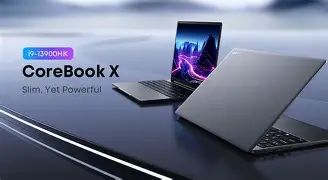
Security features
Security-conscious buyers should check for features such as a fingerprint reader, TPM module, webcam privacy shutter, and BIOS-level security options. If hardware encryption, secure boot, or enterprise management are required, confirm the presence and version of TPM and whether the laptop firmware supports the organization’s security policies.
Common buying mistakes — and how to avoid them
- Assuming premium support comes with the price: Mistake — assuming Chuwi offers the same level of warranty and fast replacements as large enterprise brands. How to avoid — check the seller’s warranty terms, ask about local repair centers, and budget for third-party extended warranties if needed.
- Skipping hands-on tests: Mistake — buying sight unseen without testing keyboard, trackpad, webcam, or display. How to avoid — try to test an in-store unit or review several video reviews focusing on usability.
- Overlooking upgrade paths: Mistake — assuming RAM or storage can be upgraded later. How to avoid — confirm whether RAM is soldered and if the SSD is a standard M.2 slot before purchase.
- Ignoring driver and OS support: Mistake — expecting quick driver updates and broad Linux compatibility without verifying. How to avoid — search for recent driver releases from the manufacturer and check community forums for driver/OS experiences.
- Underestimating thermal limits: Mistake — expecting sustained heavy workloads from a thin chassis. How to avoid — match the laptop to the workload; if compiling code or video exporting is frequent, choose a higher-performance model.
- Not validating webcam/mic quality: Mistake — assuming video meeting quality will be good. How to avoid — test audio and camera or look for sample calls in reviews.
- Not checking return and exchange policy: Mistake — buying from a third-party seller with restrictive returns. How to avoid — confirm return window, restocking fees, and how international purchases are handled.
Pros & Cons
- Pros
- Attractive price-to-design ratio for a thin, lightweight chassis
- Suitable for typical office tasks, remote meetings, and travel
- Clean aesthetic that resembles premium ultraportables
- Good baseline battery life under light to moderate use
- Cons
- After-sales support and warranty coverage can be inconsistent by region
- Potentially limited upgradeability (soldered RAM or proprietary components)
- Thermal throttling under sustained heavy workloads
- Driver and firmware update cadence may lag behind mainstream OEMs
How the Corebook Air compares: simple comparison table
| Feature | Chuwi Corebook Air | Typical Business Ultraportable (e.g., premium models) | Value-focused Competitors |
|---|---|---|---|
| Price | Very competitive; strong value positioning | Premium pricing with business warranty options | Competitive; similar cost savings but different trade-offs |
| Build & Finish | Attractive, slim, generally good finishes | Robust, tested chassis with enterprise certifications | Good for the price; some plastic components common |
| Performance | Good for everyday tasks; limited sustained performance | Stronger sustained multi-core performance and cooling | Similar to Corebook in many cases; varies by model |
| Ports & Expandability | Reasonable selection; upgradeability may be limited | Balanced port selection; designed for IT serviceability | Often similar compromises to stay thin and cheap |
| Support & Warranty | Varies by seller/region; may be limited | Comprehensive enterprise options available | Varies; some manufacturers offer regional support |
| Battery Life | Good for moderate daily use | Optimized for long enterprise-day endurance | Comparable with minor differences |
| Security Features | Basic options may be present; confirm TPM/fingerprint | Advanced options, dedicated management, and certs | Depends on model; sometimes includes business features |
Buying guide: what business buyers should prioritize
1. Confirm the target workload
Match the laptop to the actual tasks. If the daily routine is email, browser-based SaaS, document editing, and occasional video calls, the Corebook Air is often sufficient. If the user frequently runs virtual machines, large spreadsheets, software builds, or video transcodes, prioritize a laptop with higher sustained CPU performance and more robust cooling.
2. Verify warranty, returns, and local support
Before purchase, confirm the exact warranty length and what it covers in the buyer’s country. Ask how repairs are handled (mail-in, depot, local service centers), expected turnaround time, and whether the seller offers a return window long enough for full testing in business conditions.
3. Check upgradeability and serviceability
For longevity, prefer configurations where the SSD is replaceable and RAM can be upgraded. If the chosen Corebook Air configuration has soldered RAM, buy the highest memory option the budget allows to avoid early obsolescence.
4. Test keyboard, trackpad, and webcam
These are daily-use components that greatly affect productivity. Test typing comfort for at least 15–20 minutes if possible. Verify the webcam angle and microphone quality in a live call; these are essential for remote meetings.
Find top-rated Laptops & Computers products at great prices.
View Offers →5. Evaluate ports and dongle needs
Check the physical port list: USB-A, USB-C, HDMI, headphone jack, microSD, or Ethernet (via adapter). Business users who present frequently or connect to legacy projectors should confirm the presence of necessary ports or budget for reliable adapters.
6. Validate drivers and OS configuration
Confirm which operating system the laptop ships with and whether drivers and firmware are current. If planning to run a corporate image, test hardware compatibility with that image. For Linux users, look for community reports of driver support for Wi-Fi, touchpad, and brightness controls.
7. Consider security and management
Confirm the presence of a TPM module if disk encryption is required, and check for biometric options like a fingerprint reader. For teams, consider whether the laptop supports remote management tools used by IT, and whether BIOS features support corporate lock-down policies.
8. Inspect battery replacement options
Understand how the battery can be serviced or replaced. If the device cannot be serviced locally, factor in potential downtime and replacement cost over the expected lifecycle.
9. Read independent reviews and user forums
Independent reviews and community forums are useful to surface recurring issues like Wi-Fi driver quirks, BIOS updates, and user-reported reliability. Prioritize recent threads and reviews that test performance under real workloads.
10. Consider total cost of ownership (TCO)
Price is one part of the decision. Factor in the cost of third-party warranties, potential downtime, necessary adapters, and the likelihood of early replacement if the configuration cannot be upgraded.
Final checks to perform on arrival
- Run a full system update and update firmware/BIOS if available.
- Test battery life with typical workload and note baseline runtime.
- Verify display for dead pixels and color uniformity.
- Confirm keyboard, trackpad, webcam, microphone, and speakers work as expected.
- Check device manager or system info for recognized hardware and available drivers.
- Create a recovery image or system backup once the device is configured.
Conclusion
The Chuwi Corebook Air can be a sensible choice for budget-conscious business users who primarily need portability, an attractive chassis, and adequate performance for everyday office tasks. The most common buying mistakes stem from treating the Corebook Air as if it were a premium enterprise device: overlooking support, assuming easy upgrades, or expecting sustained high performance. By clearly defining workload needs, verifying warranty and upgrade options, testing key inputs and conferencing hardware, and factoring in total cost of ownership, buyers can make an informed decision and avoid the costly pitfalls that come from mismatched expectations. When chosen with care, the Corebook Air can deliver a lot of practical value — but it works best when buyers understand its trade-offs and plan for them up front.